A warm welcome,
It’s lovely to have you here – virtually – on the Mosel Camino!
Welcome (engl.) Bienvenue (franz.) Wëllkomm (letzeb.) Bienvenido (span.) Bem-vindo (port.) Welkom (fläm.) Benvenuto (ital.) Tervetuloa (finn.) Välkommen (schwed.) Velkommen (norw./dän.) Serdecznie witamy (poln.) tere tulemast (estn.) laipni lūdzam (lett.) šiltas pasveikinimas (lit.) Bud'te vitán (tschech.) Szívesen látott (ungar.) Dobrodošel (slow.) Dobrodošli (kroat.) Добродошли (serb.) Bine ati venit (rumän.) Eυπρόσδεκτος (griech.) Misafirlikte (türk.) ברוך הבא (hebr.) Добро пожаловать (russ.) Ласкаво просимо (ukr.) Karibu (kisuah.) أهْلاً و سَهْلاً (arab.) 受欢迎的 (chin.) ようこそ (jap.) स्वागत (hindi) উষ্ণ স্বাগত (beng.) 따뜻한 환영 (korean.) گرمجوشی سے استقبال (urdu) Te salvere iubemus (lat.) Bonvenon (Esperanto) ...
(We cannot guarantee the accuracy of the translations!)
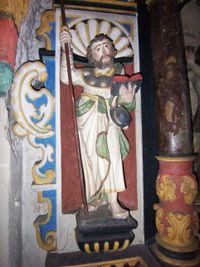
... perhaps you, too, will soon be setting off for Trier and/or even Santiago de Compostela ... Ultreia!
Please note:
Content may be used and copied for private purposes; linking to the content is also permitted. In all other cases, particularly where content is used for commercial purposes, authorisation from the website operator (see Legal Notice) is required and, where applicable, the source must be correctly cited (copyright)!
Notes on the page layout:
- To open the menu or the subpages, click on the three horizontal lines in the top left-hand corner.
- Terms in red are linked to further information.
- The images (unless otherwise stated, my own photographs) can be enlarged > just click on them!
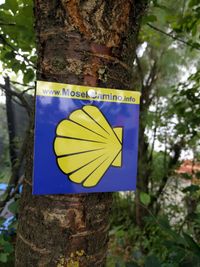
Since 2008, the Mosel-Camino (camino: Spanish for ‘path’) has formed part of the St James’ Way pilgrimage route to Santiago de Compostela and, as such, is fully signposted from Koblenz-Stolzenfels (start) to the Benedictine Abbey of St Matthias in Trier (end) along an extremely varied and scenically stunning route. It was originally conceived as a private initiative by Karl-Josef Schäfer and Wolfgang Welter, the operator of this website.
Numerous signs and stickers featuring a yellow scallop shell on a blue background, as well as yellow arrows, guide walkers along a route of around 160 km (or slightly longer, depending on detours and sightseeing stops) to the tomb of the Apostle Matthias. The converging ribs of the shell act, as it were, as an arrow pointing the way there.
As regards its route, the Mosel-Camino is independent of any direct influence from local authorities, the Church or any other body; however, it is placed under the patronage of the St James’ Brotherhood in Trier, has been agreed with the relevant local authorities and has been approved by the responsible Rhineland-Palatinate Structural and Approval Directorate North.
The trail was initially funded by grants from individual local authorities, and has since been funded through corporate sponsorship; the signposting is carried out by trail sponsors on a purely voluntary basis (see here!).
The Mosel-Camino is not intended to be a premium walking route, nor is it designed to maximise the number of ratings from relevant walking organisations (see here).
Rather, he wishes to guide pilgrims ** and walkers ** through the beautiful countryside shaped by the Moselle, along the shortest possible yet varied and scenic route, past many notable spiritual and cultural sites, whilst taking into account the availability of public transport, to Trier.
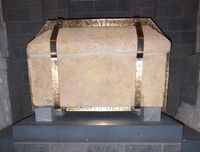
For pilgrims on the Way of St James **, this – in conjunction with the Ecumenical Pilgrimage Route, the Elisabeth Trail (2) and the Lahn-Camino (Görlitz – Eisenach – Marburg – Lahnstein) – the opportunity has now been created on both sides of the Moselle and the neighbouring hills for pilgrims to make the journey in a north-east > south-west direction to Trier, to the tomb of the Apostle Matthias (picture), and from there on to Santiago de Compostela.

Although the (opposite) course of the Moselle (blue) broadly indicates the south-westerly direction towards the diocesan city, in order to bypass the meanders typical of the Moselle, the route (shown in green on the map) also takes the pilgrim up to the occasionally exposed heights of the Eifel and Hunsrück.
Medieval castles and ruins, as well as venerable (monastic) churches, chapels and wayside shrines, line the pilgrimage route time and again.
Traditional places of pilgrimage alternate with romantic wine-growing villages and towns. Numerous museums invite visitors to explore them.
The difficulty level of this route is certainly challenging overall, but not excessively so; nevertheless, due to a number of steep sections in the ‘Wingert’, a reasonable level of fitness, sure-footedness and suitable footwear are required.
The route is marked on the latest editions of the relevant LVermGeo walking maps (1:25,000)!
Good public transport links make it possible to walk the route in individually chosen sections, even as a day or weekend pilgrim.
The Way of St James in Germany … important to know
The Way of St James routes in German-speaking countries are undoubtedly scenic and offer a wealth of spiritual and cultural experiences.
Although there is a dense network of Way of St James routes and feeder routes here, the traditional pilgrim infrastructure is, in many places, less well-developed than on the heavily frequented routes in France or Spain. Whilst there are pilgrim hostels as well as church-run and private accommodation providers in Germany too, their density, availability, facilities and prices are often less consistent.
Whilst some accommodation operates on a donation basis or charges only small fees, in other places guesthouses, inns or hotels are the only option for overnight stays. Particularly in regions popular with tourists, one cannot always count on pilgrim accommodation being available at short notice; booking in advance is therefore often advisable.
The experiences and expectations that pilgrims bring with them from the traditional Way of St James routes in France or Spain can therefore only be applied to a limited extent to the German Way of St James routes. Anyone undertaking a pilgrimage in Germany should be prepared for different conditions, a greater variety of accommodation options and, in some cases, higher costs.
We are happy to answer any questions about the route – via the contact form or by email (see below for the address).
Road closures/diversions: see here
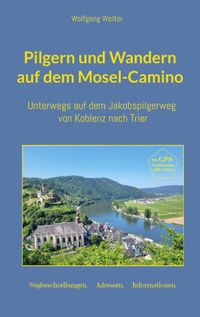
You can access the pilgrimage and walking guide ‘Pilgrimage and Walking on the Mosel-Camino’ hier.
St James’s Pilgrimage Routes to Trier
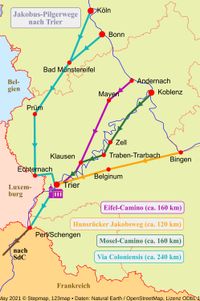
From Klausen, the Eifel Camino, which comes from Namedy/Andernach, also follows the route of the Mosel Camino; in the Biewer district of Trier, the Way of St James from Cologne/Bonn to Trier (= Via Coloniensis) joins it. Since June 2013, the network of St James’s Ways heading towards Trier has been supplemented by the Hunsrück Way of St James, which starts in Bingen (identical to the Ausonius Way, managed by the Hunsrück Association).
Information on the route from Trier towards France/Luxembourg can be found here (scroll down)
Google Maps view (featuring a selection of special places)... can be found hier
Routenplaner
Microsoft Bing
* 'Ultreïa' ist der Gruß der Pilger auf dem Jakobsweg: "Geh weiter, geh über dich hinaus, geh an deine Grenzen“. Der zweite Teil des Refrains „Deus, adjuva nos“ ergänzt den Gruß der Pilger und fügt damit den Wunsch um Gottes Segen an. Mehr dazu hier
Letzte Bearbeitung in English: 14.11.2026
- Seite 1 'Willkommen' -